Recycling initiative launched for dairy farmers

Animal health business Zoetis is working with Australian dairy farmers and veterinarians to contribute to a greener environment and help local communities. It has launched a recycling initiative for dairy farmers in partnership with TerraCycle, with the aim of keeping plastic waste out of landfill. The initiative sees plastic syringes melted down and pelletised, with the raw material able to be made into new items such as garden beds, watering cans and outdoor furniture.

The program supports the recycling of empty Teatseal Syringe packaging. Teatseal is a non-antibiotic product used to prevent mastitis infections during the dry-off period. It is administered using a plastic syringe that is not recyclable in kerbside bins — which can generate significant plastic per farm depending on herd numbers.

“Teatseal is made from a mix of plastics that can’t go in kerbside recycling. Through our new partnership with Zoetis, we’re able to provide farmers and veterinarians with solutions to divert these plastics from landfills so they can be repurposed,” said Jean Bailliard, General Manager, TerraCycle ANZ.

Zoetis has partnered with 100 veterinary clinics across Australia to enable farmers to return used syringes to their local participating clinic, where they are placed in a recycling box.

In the last three years, the Australian Government strengthened its commitment to ensure the Australian agriculture sector is contributing to global sustainable development goals. Australia produces around 8000 t of waste farm plastics a year, with only a small percentage currently being recycled.

Lance Williams, Zoetis Senior Vice President and Cluster Lead Australia & New Zealand, said following the success of a similar program in New Zealand, Zoetis is “impressed” by the willingness of veterinary clinics and dairy farmers to participate in the initiative.

The program has returned over 495 kg of plastic since its launch, a figure that Zoetis plans to build on to achieve carbon neutrality by 2030.

source http://sustainabilitymatters.net.au/content/sustainability/case-study/recycling-initiative-launched-for-dairy-farmers-323915019

Reusing sloppy sludge to fix sewer pipe problem

To address the problem of cracking sewer pipes in Australia, a project led by University of South Australia sustainable engineering expert Professor Yan Zhuge is trialling a novel solution designed to halt corrosion in aging concrete pipelines. The project could see 117,000 km of sewer pipes being prevented from cracking without any intervention by humans, and may save $1.4 billion in annual maintenance costs.

The lifespans of pipes are being reduced by corrosive acid from sulfur-oxidising bacteria in wastewater, along with excessive loads, internal pressure and temperature fluctuations, costing hundreds of millions of dollars to repair every year across Australia.

The solution may be ‘self-healing concrete’, in the form of microcapsules filled with water treatment sludge.

“Sludge waste shows promise to mitigate microbial corrosion in concrete sewer pipes because it works as a healing agent to resist acid corrosion and heal the cracks,” Zhuge said.

Microcapsules with a pH-sensitive shell and a healing agent core containing alum sludge — a by-product of wastewater treatment plants — and calcium hydroxide powder will be developed by researchers. This combination will be designed to be highly resistant to microbially induced corrosion (MIC).

To protect from breakage, the capsules will be embedded inside concrete at the final step of mixing. They will release the healing agents when the pH value changes as acid levels build up.

“This technology will not only extend the lifetime of concrete structures, saving the Australian economy more than $1 billion, but it will promote a circular economy as well by reusing sludge that would normally end up in landfill,” Zhuge said.

Existing repairs of deteriorating concrete are often short-lived, with 20% failing after five years and 55% failing after 10 years.

Existing methods to contain acid corrosion in sewer pipes are unsuccessful for a variety of reasons. Chemicals that may be added to wastewater to stop corrosion are costly and contaminate the environment. Another option involves increasing the speed of sewage flow by amending pipe hydraulics, but this may be ineffective. A popular option is surface coating, but it is time-consuming and temporary.

According to Zhuge, the construction industry is being forced to transit to a circular economy to be carbon-neutral by 2050.

“Industry by-products or municipal wastes that would normally be discarded in landfill sites, potentially generating pollution, may now be reused in the construction production chain,” she said.

A single drinking water treatment plant generates up to 2000 t of treated water sludge annually, most of which is disposed in landfill, causing environmental issues and costing more than $6 million each year. Mainland Australia alone has about 400 plants.

Disposing of one tonne of sludge in landfill releases approximately 29.4 t of carbon dioxide emissions — much higher than cement production — and leaks aluminium into the soil and water, a risk factor for Alzheimer’s disease.

“We are confident this novel self-healing concrete based on advance composite technology will address issues of sewer pipe corrosion and sludge disposal in one hit,” Zhuge said.

The project involves researchers from the University of South Australia and University of Queensland, partially funded by a $501,504 Australian Research Council grant.

Image caption: iStock.com/Docter_K

source http://sustainabilitymatters.net.au/content/wastewater/case-study/reusing-sloppy-sludge-to-fix-sewer-pipe-problem-625764306

SA trialling advanced soft plastics recycling scheme

Led by the Australian Food and Grocery Council (AFGC) in partnership with the Central Adelaide Waste and Recycling Authority (CAWRA), and the Cities of Adelaide, Charles Sturt and Port Adelaide Enfield, a kerbside recycling trial in South Australia is part of designing an industry-led scheme for recycling soft plastic packaging in Australia. The scheme aims to create an advanced recycling industry, producing recycled, food-grade soft plastic packaging, which currently isn’t made in Australia.

In the trial, set to hit a small number of SA households, residents in designated areas will receive kits with specially designed bags to be filled with eligible soft plastic packaging, such as bread and frozen vegetable bags, ice-cream wrappers and toilet paper wrap. Full bags go into the household recycling bin for the regular council kerbside collection, after which the special bag will be sent to manufacturers for processing.

This trial is one of a number being conducted as part of the National Plastics Recycling Scheme (NPRS) project, co-funded by food and grocery manufacturers and state and Commonwealth governments. The trials are designed to help validate the model for kerbside collection and sorting, one that provides a clean stream of used soft plastics and can be scaled up for an emerging advanced recycling industry.

Different bags are being tested by the three councils, with the Cities of Adelaide and Port Adelaide Enfield both testing the yellow ‘Curby’ bags and the City of Charles Sturt testing an orange, translucent bag. Soft plastics cannot be recycled in the trial unless they are placed in the coloured bags. In total, 4000 households will participate in the trials across the three councils.

AFGC CEO Tanya Barden said the trials are a key part of capturing soft plastic packaging as a resource to help meet demand from Australia’s food and grocery manufacturers for food-grade recycled packaging.

“Soft plastic packaging plays a vital role ensuring the freshness and protection of food, personal care and home care products,” Barden said. “Manufacturers use soft plastics because they are strong and light with a low carbon footprint and the industry is committed to further improving the environmental profile of this material.”

The advanced recycling process will break clean, shredded soft plastics back down into new products such as oil — from which plastics are made from in the first place. That oil is then refined and made back into new plastics.

The NPRS trials are supported by funding from the Australian food and grocery manufacturing industry and the Australian Government while the South Australian trials have received funding from Green Industries SA and the participating councils.

Work on the recycling scheme has stimulated new investment in advanced recycling infrastructure since securing a grant under the federal government’s National Product Stewardship Investment Fund in 2020. There are now four facilities either in development or operation.

Image caption: iStock.com/Daria Nipot

source http://sustainabilitymatters.net.au/content/sustainability/news/sa-trialling-advanced-soft-plastics-recycling-scheme-1288553586

Closing the loop on nappies: an Aussie trial

Kimberly-Clark, the maker of Huggies nappies, has announced a nappy recycling trial that may be Australia’s answer to the 1.5 billion disposable nappies that end up in landfill each year. Approximately 300,000 babies are born in Australia every year, and about 95% of them wear disposable nappies.

The Nappy Loop has been underway in South Australia since July 2022. Claimed to be the first nappy recycling trial of its kind in Australia, it uses anaerobic digestion to turn the organic materials in used Huggies nappies into nutrient-rich compost, as well as bioenergy that is captured and used to power the recycling process.

Led by Kimberly-Clark Australia, along with CSIRO, Peats Soils and Garden Supplies, Solo Resource Recovery, and early learning and care provider G8 Education, the Nappy Loop team has collected and recycled almost two tonnes of used Huggies nappies, to help prove that anaerobic digestion is a viable option for the nappy recycling process.

Kimberly-Clark ANZ Managing Director Belinda Driscoll said, “Families and day care centres across the country rely on the convenience and performance of disposable nappies and while we work to innovate and create more sustainable products, recycling is one solution for disposable nappy waste. Identifying a recycling solution that works hasn’t been easy due to the availability of technology and collection systems. Today is a very proud day for us, announcing that we have trialled right here in Australia, and it represents a big step in Kimberly-Clark ANZ’s sustainability strategy.”

How the trial worked

The Nappy Loop trial has adopted a B2B model. Solo collected used Huggies nappies from G8 Education’s Welly Road Early Learning Centre in Mount Barker and delivered them to the Peats composting facility for processing. There, the anaerobic digestion process takes place and the plastic components from the nappies are separated from the organic matter and evaluated for future recycled products. In addition, bioenergy captured from the anaerobic digestion process is used to power the Peats composting facility.

CSIRO is validating the results of the trial and the full report will be available soon. However, initial results
show:

  • The anaerobic digestion process was beneficial in biodegrading the organic matter in nappies (post separation of plastics) when mixed with expired food waste and beverages with high sugar content. Food waste and beverages not only help in separating the plastics from the shredded nappies but also provide additional liquid content and sugars for the anaerobic digestion process.
  • The anaerobic digestion process was able to turn the fluff pulp and other organic components of the soiled nappies (after separating plastics) into nutrient-rich compost and biogas. CSIRO is still assessing how much biogas is produced from the degradable organics in nappies. However, early test results indicate a successful conversion of organic carbon during the digestion of nappies (post separation of plastics) to biogas.
     

CSIRO’s Principal Research Scientist Dr Anu Kumar said, “CSIRO is working with Kimberly-Clark Australia to provide scientific validation of The Nappy Loop pilot to help tackle waste. Our research for this Australian trial will help inform the team on the potential scaling of the program to help reduce the amount of nappies ending up in landfill.”

Managing Director of Peats Soils and Garden Supplies Pete Wadewitz said: “Anaerobic digestion is a growing area of focus and possibility in Australia. The process has been used successfully in Toronto, Canada to recycle disposable nappies and we are excited to be introducing this innovative approach in the Southern Hemisphere as we work to solve the nappy waste issue.”

G8 Education Head of Early Learning and Education Ali Evans said, “Through this partnership the nappies changed every day at our Welly Road centre are recycled instead of going into landfill. As educators of our future generations, sustainability is a core focus in all our 440 centres across Australia and we’re excited to contribute to this partnership and the positive environmental impact it can make.”

After a five-month trial, The Nappy Loop is exploring the opportunity to scale the program in South Australia and nationally. This includes a partnership with APR Plastics to test the recycling of the recovered plastic from the nappies using pyrolysis, with the aim of having results available in early 2023.

source http://sustainabilitymatters.net.au/content/sustainability/news/closing-the-loop-on-nappies-an-aussie-trial-758380075

Using smoke to draw out sneaky stormwater

SA Water is set to begin discharging small amounts of artificially generated smoke into Naracoorte’s sewerage network to test for any incorrect or illegal stormwater connections as well as broken or cracked sections of pipe.

The commonly used method will help SA Water identify where stormwater is entering the sewers, which can contribute to overflows following a heavy rain event.

After putting the smoke into the network, the utility will look for escape points such as stormwater downpipes on the side of a building’s roof guttering, or from the road surface of a broken inspection point lid.

Peter Seltsikas, Senior Manager of Capital Delivery, SA Water, said Naracoorte was selected for this testing due to the high number of sewage overflows at the local treatment plant’s pump station after heavy downpours.

He says that SA Water is taking a proactive approach to identify sources of intrusion after monitoring indicated there may be points in the network receiving excess stormwater after rain. Though a level of stormwater infiltration is normal, recent events have overwhelmed Naracoorte’s network and significantly raised the volume and flow of sewage.

“The increased flow also elevates the risk of overflows to the environment or onto a person’s property and we want to help minimise the chance of this to ensure our sewers are able to continue protecting public health,” Seltsikas said.

Information gathered during the inspections will inform a range of solutions, such as repairs or remediation options for local property owners.

“We appreciate that some people may not be aware they have an illegal stormwater connection on their property, but it’s important the issue is rectified to reduce the risk of overflows and keep our sewers healthy,” Seltsikas said.

The odourless, grey smoke, similar to that used at concerts or for special effects, is harmless to people, plants, animals and the environment. It does not stain and it dissipates within a few minutes.

The inspections will take place between 7 am and 5 pm each day until Thursday, 8 December.

SA Water has informed the local community and the Country Fire Service of the work. It may require access to easements along the roadside, as well as driveways and front yards.

“There will be no disruption to our local customers’ sewerage service as a result of the work, and they can keep using taps and other plumbing fixtures as per usual, as smoke won’t come out where there is a water seal, such as in a toilet,” Seltsikas said.

source http://sustainabilitymatters.net.au/content/wastewater/news/using-smoke-to-draw-out-sneaky-stormwater-226569409

SA Water’s $1.6 million upgrade

A $1.6 million upgrade of SA Water’s wastewater pump station in Queensbury is underway. The project aims to improve odour control and support ongoing residential growth.

The pump station, located in Adelaide’s western suburbs, collects more than 15 million L of sewage each day and pumps it to the utility’s Bolivar Wastewater Treatment Plant where it’s treated and recycled.

As part of the project, the site’s existing odour control unit — which consists of bio-filters — will be upgraded and the wastewater main that discharges sewage into the pump station will be aligned.

Amanda Lewry, General Manager of Sustainable Infrastructure, SA Water, said the upgrade will aim to minimise the impact of odour released from the network on local residents. She said treatment plants may play an essential role in protecting public health, and with the increase of residential growth in the area, the site’s capacity to extract and treat odour will be increased.

According to Lewry, the existing four bio-filters in the site’s control unit will be replaced and two more will be added. These filters harness air to help microorganisms break up organic material in sewage.

In addition to this, two activated carbon filters will be added to the site to double the extraction rate. These will help neutralise odours by trapping molecules in a process called adsorption.

The combined processes are expected to eliminate 99% of odour, according to Lewry.

“As part of the project, we’re also realigning a section of the pipe along Davidson Avenue that brings sewage into the pump station, to relocate the point at which it releases odour, so it’s better contained to the site. There is still potential for a slight aroma, particularly on hot and still days, but the upgrades we’re delivering will keep this to a minimum,” she said.

The project is expected to be completed by early 2023.

source http://sustainabilitymatters.net.au/content/wastewater/case-study/sa-water-s-1-6-million-upgrade-22114134

Next-level blue hydrogen production with advanced measurement

While hydrogen production was previously seen as a cost to refinery operations, sales of clean hydrogen now present an opportunity to increase plant profitability. Next-gen tech is now proving maximise blue hydrogen production, energy efficiency and meet CO2 capture targets.

Learn about advanced measurement solutions that can maximise your plant safety and reliability, increase operational efficiency and reduce energy consumption.

source http://sustainabilitymatters.net.au/content/sustainability/white-paper/next-level-blue-hydrogen-production-with-advanced-measurement-507275282

Research team using magnets to remove microplastics from water

Researchers at RMIT University have found a way to remove hazardous microplastics from water using magnets.

Lead researcher, Professor Nicky Eshtiaghi from RMIT’s School of Environmental and Chemical Engineering, said existing methods could take days to remove microplastics from water, while their invention does so in one hour.

The team said they have developed adsorbents, in the form of a powder, that remove microplastics 1000 times smaller than those currently detectable by existing wastewater treatment plants.

The researchers successfully tested the adsorbents in the lab, and they plan to engage with industry to further develop the innovation to remove microplastics from waterways.

The research results are published in the Chemical Engineering Journal.

“The nano-pillar structure we’ve engineered to remove this pollution, which is impossible to see but very harmful to the environment, is recycled from waste and can be used multiple times,” Eshtiaghi said.

“This is a big win for the environment and the circular economy.”

Using nanomaterials, the researchers developed an adsorbent that can be mixed into water to attract microplastics and dissolve pollutants.

Muhammad Haris, the first author and PhD candidate from RMIT’s School of Environmental and Chemical Engineering, said the nanomaterials contained iron, which enabled the team to use magnets to easily separate the microplastics and pollutants from the water.

“This whole process takes one hour, compared to other inventions taking days,” he said.

Co-lead researcher, Dr Nasir Mahmood from Applied Chemistry and Environmental Science at RMIT, said the nano-pillar structured material was designed to attract microplastics without creating any secondary pollutants or carbon footprints.

“The adsorbent is prepared with special surface properties so that it can effectively and simultaneously remove both microplastics and dissolved pollutants from water,” Mahmood said.

“Microplastics smaller than 5 millimetres, which can take up to 450 years to degrade, are not detectable and removable through conventional treatment systems, resulting in millions of tonnes being released into the sea every year. This is not only harmful for aquatic life, but also has significant negative impacts on human health.”

The team received scientific and technical support from the Microscopy and Microanalysis Facility and the Micro Nano Research Facility, part of RMIT’s newly expanded Advanced Manufacturing Precinct, to complete their research.

Eshtiaghi said the next step is developing a cost-effective way to overcome these significant challenges posed by microplastics was critical.

“Our powder additive can remove microplastics that are 1000 times smaller than those that are currently detectable by existing wastewater treatment plants,” she said.

“We are looking for industrial collaborators to take our invention to the next steps, where we will be looking at its application in wastewater treatment plants.”

Eshtiaghi and her colleagues have worked with various water utilities across Australia, including with Melbourne Water and Water Corporation in Perth on a recent Australian Research Council Linkage project to optimise sludge pumping systems.

Image caption: Dr Nasir Mahmood, PhD candidate Muhammad Haris and Professor Nicky Eshtiaghi (left to right) with a sample of water with microplastics and a vial of clean water following its treatment with their innovation. Credit: RMIT University

source http://sustainabilitymatters.net.au/content/wastewater/case-study/research-team-using-magnets-to-remove-microplastics-from-water-236398807

Qld solar farm one step closer to target

In partnership with Salesforce, X-ELIO has launched its Blue Grass Solar Farm, located 14 km from Chinchilla in Queensland’s Western Downs.

One of Queensland’s 50 large-scale renewable projects, the 200 MW solar farm will help support the state government’s renewable energy target (QRET) to generate 70% of its energy needs from renewable sources by 2032 and 80% by 2035, a target recently announced as part of the Queensland Energy and Jobs Plan.

Using 375,000 bifacial solar panels and half-cut cells, the farm is designed to deliver 420 GWh green energy annually, offsetting over 320,000 t of CO2 emissions and powering 80,000 homes across the state.

The project’s construction and grid connection was supported by renewable and transmission specialists, including Gransolar Group (GRS), Ingeteam and Powerlink. It received financial backing from Clean Energy Finance Corporation (CEFC), ING, Sumitomo Mitsui Banking Corporation (SMBC) and already-established long-term support from first-tier offtakers Salesforce, Stanwell Corporation and ZEN Energy.

The Blue Grass Community Support and Benefit Sharing Fund will allocate a percentage of the project’s income to four local community initiatives. The recipients are the Resourcing Country District Instrumental Music Program, which will provide musical instruments to students of over 400 schools throughout the region; the Friends of Illoura Village, which will purchase an accessible bus to transport the elderly and disabled around the local community; the Western Downs Emergency Services Unit, which will establish a Mobile Emergency Operations Centre trailer to support future SES operations in remote locations; and a local parents association, which will oversee the fencing of a park located next to the Warrego Highway.

source http://sustainabilitymatters.net.au/content/sustainability/news/qld-solar-farm-one-step-closer-to-target-619547634

The Fundamentals of Moisture Calibration

Why humidity calibration is important

Reputable manufacturers will provide calibration certificates with instruments or sensors at the time of purchase. However, this is not a guarantee of the measurement performance throughout the entire lifetime of the equipment. Over time, the ageing of mechanical and electronic components can cause changes in the characteristics of sensor or instruments. More critically, once the device has been used in the field, and possibly introduced to contaminants which can have an impact on accuracy, it is difficult to say with any degree of certainty whether or not the original calibration is still valid.

How is the calibration data used?

When the readings provided by the sensor or instrument are critical to a process or testing procedure, it is vital to know that the device is still performing within its original specifications, or if the correction factors have changed. When an instrument is recalibrated, a report is provided showing the calibration corrections before and after any adjustment was performed. For many hygrometer users, these ‘readings before’ are crucial, as they can be retrospectively applied to readings taken in the period before calibration.

In order to minimise uncertainty and have confidence in measurements made with the instrument, it is important to have the quality assurance of a regular, accredited calibration procedure.

What is humidity calibration?

Calibration is the process of comparing a measuring instrument against an authoritative reference to identify any bias or systematic error in the readings. The reference instrument in any calibration should ideally be at least 10 times as accurate as the instrument under test to avoid the tolerances of the reference influencing whether the test instrument is classed as a ‘pass’ or ‘fail’. Generally, a calibration will be performed by repeating the process of comparison at a representative selection of points across the measurement range.

Calibration is often interpreted as ‘adjustment of an instrument to read correctly,’ but this is a misconception. Adjustment of an instrument to match a calibrated reference is a separate concept. It is a process which is usually carried out by an equipment manufacturer by internally applying the calibration corrections to bring the output readings into line with the indications of the calibration reference.

Image caption: iStock.com/barbol88

Calibration Standards and Traceability

The best way to ensure accuracy of measurement is through traceability to attested standards.

This leads to consistency of measurements across different instrumentation, locations and users. ‘Traceability’ is an unbroken chain of calibrations which relate a working hygrometer back to a national standard.

Most countries hold their own authoritative national standard for dew point and humidity, which forms the primary measurement standard. Alternatively, reference standards are shared across a region. The reference instruments of calibration facilities in the country or region are calibrated against this primary standard, and are then used as references or ‘transfer standards’ to calibrate other instruments.

This approach is represented by the pyramid graphic below (Figure 1).
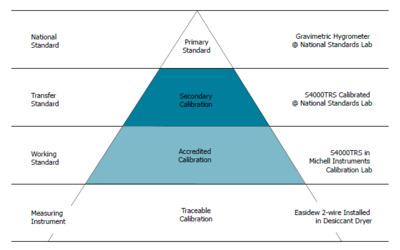
Image caption: Figure 1

How is a Humidity Calibration Carried Out?

Humidity calibrations involve generating a stable level of humidity in a sample gas and measuring this with both a suitable fundamental reference instrument and the instrument under calibration, then making a comparison of the readings.

A humidity calibration system comprises of:

  • A dry air source
  • A humidity generator to provide the desired moisture content
  • A reference instrument which is more accurate than the instrument under test to provide an authoritative measurement
  • A manifold to supply calibration gas to the sensors/instruments under test

If the calibration is being performed in terms of relative humidity and temperature, then the manifold must be temperature controlled or placed in a temperature-controlled environment in order to determine the relative humidity by associating the generated dew-point value with the temperature.

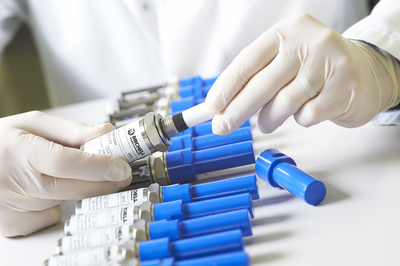
Michell Instruments is the only supplier to offer complete dew-point calibration systems and individual calibration components, all of which are designed and built in-house.
A Typical Calibration Certificate

A calibration certificate will contain a table with a list of calibration points:

The 1st column shows the measured value indicated by the reference instrument.

The 2nd column shows the measured value indicated by the instrument under calibration.

The 4th column shows the correction that should be applied to any measured values obtained from the instrument under calibration.

Generally, if the instrument under calibration has multiple ways to report the measured value, (i.e. built-in display, digital output, analog voltage or current outputs), then the values taken from these different outputs will also be shown on the certificate at each calibration point.

Other information that should be included on the calibration certificate is:
  • Customer details, sometimes including the customer’s address, customer number or order number
  • Any serial numbers that identify the instrument and associated measuring components
  • The date of the calibration, and sometimes the date when the subsequent calibration is due
  • A unique reference number identifying the certificate or calibration run
  • A list of calibrated equipment used during the calibration, or a list of unique identifiers corresponding to that equipment
  • An estimation of uncertainty over the range of the calibration

In-House Calibration vs. External Calibration

Meteorological organisations, standards laboratories, pharmaceutical manufacturing plants and other businesses or institutions that operate many calibrated instruments or sensors must have an effective calibration system in place. It is usually more sensible to perform calibrations in-house, rather than managing the cost and downtime (or availability of replacement calibrated sensors) associated with sending equipment away to an external commercial calibration laboratory.

However, purchasing and operating a dedicated humidity calibration system can be a significant commitment in terms of initial cost, personnel training, record keeping and in some cases physical space. For companies that use a small number of humidity instruments, sending these to a commercial calibration laboratory for regular calibration is the most cost-effective solution.

source http://sustainabilitymatters.net.au/content/water/sponsored/the-fundamentals-of-moisture-calibration-611072456