Tidal turbine to light the Thames

A small proportion of the River Thames is to be illuminated using power generated by the flow of the river itself, as Kingston University tests prototypes of a new hydroelectric turbine design.

Based on the traditional water wheel, the new design is mounted on a vertical axis that sits on a pontoon. On this will be an array of test sensors and monitors, including a TorqSense wireless torque sensor from Sensor Technology Ltd.

The turbine under test has been developed by Hales Marine Energy near Eastbourne on the English south coast and is expected to be deployable in tidal seas as well as rivers. Designed to fit on a submergible tank, the turbine will sit on the sea bed and can be floated up to the surface when required. The unit under test is 1 m diameter and produces about 1 kW but the design is scalable — 5 m turbines suitable for inshore deployment would generate round 20 kW; smaller units would be suitable for river use.
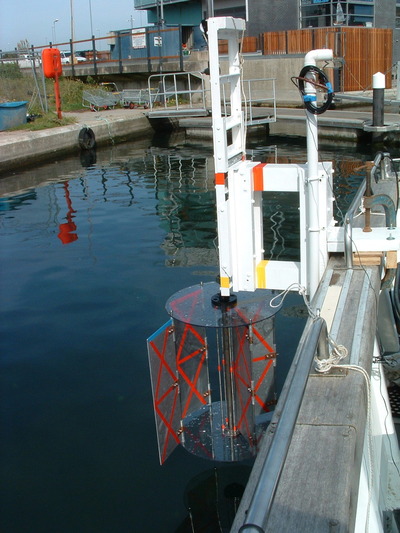
With access to the test site being by small boat, Rod Bromfield, Senior Lecturer of the Faculty of Engineering, Kingston University knew that his test regime had to be both simple and comprehensive.

“The critical measurement is torque, as this indicates the power we can derive from the system. We had to be certain that we would get continuous measurements over an extended period of time, because we need to map power production against actual river flow. Also, for this technology to succeed in the emerging green power market it must be capable of continuous and predictable energy production,” Bromfield said.

One of the engineering issues that Bromfield faced was the relatively slow revolution of the turbine — in this test below 50 rpm. This helped define the choice of the TorqSense, but it is also a key feature of the Hales turbine — the slow speed means less stress on moving parts and therefore less servicing. It also minimises habitat disturbance, so that the ecological impact is low.

“When I contacted Sensor Technology I was very concerned about vertical mounting and harsh environment performance,” Bromfield said. “Fortunately there have been TorqSenses installed vertically, including several high up on vertical axis wind turbines, where they have to withstand gales, hurricanes and lashing rain.”

“To overcome the high resistance on the wheel blades that on one side are trying to move against the water flow, they are shaped and hinged to present a minimum resistance. The large blade area on the drive side produces very high amounts of torque (rotational force) at low speed, in the range of 10–20 rpm.

“Coupled with modern permanent magnet generators that can start producing electricity rotations as low as 2 rpm, my turbine can offer the possibility of tidal generation worldwide,” Bromfield said.

“Water is nearly 800 times denser than air so it carries far more energy, making water turbines a very attractive alternative to wind energy.”

The simplicity of the design, its robustness and low maintenance, relative ease of installation could also make it suitable for deployment in remote and less developed areas.

Image credit: iStock.com/SHansche

source http://sustainabilitymatters.net.au/content/energy/case-study/tidal-turbine-to-light-the-thames-1452705152

Nature-based solution tested at wastewater plant in Vic

The Restorative Wetland Carbon Storage pilot project at Cowes, in the Bass Coast Shire of Victoria, is studying how floating wetlands can be used to manage treated effluent and emissions produced from wastewater treatment.

The Labor government has invested $250,000 towards this project as part of the Integrated Water Management grant program, which co-invests in wastewater and stormwater projects that can contribute to water security, public and environmental health, and urban amenity.

The study is being run by Westernport Water, and its findings will be shared with the broader water industry and community.

Victorian Minister for Water Harriet Shing recently inspected the pilot project and said: “This pilot project will support the water industry [to] adapt to climate change and population growth, and provide multiple environmental benefits such as improved biodiversity, habitat and water quality.”

Member for Bass Jordan Crugnale said: “Nature-based solutions are important to the community and this pilot is just one example of many local innovations that will ensure the Bass Coast is well-positioned to meet future challenges.”

This project is one of 11 metropolitan and 17 regional projects receiving a funding boost under the first round of the $14.1 million grants program.

A new liner and cover have also been installed at the San Remo Basin ensuring that Westernport Water can continue to provide consistent and reliable drinking water services for another 30 years.

The $2.6 million project will help prevent evaporation of the water supply from the San Remo water storage basin. The works were finished three months ahead of time and under budget without any impact to customers.

The San Remo Basin can store up to 30 million litres or about five days of supply and is an important part of the water supply system, providing safe and reliable storage for Phillip Island and surrounding areas.

“Renewal of critical assets like the San Remo Basin is essential to the ongoing supply of water services that meet, or exceed customer expectations — meaning reliability for families, businesses and the local community,” Crugnale said.

Image credit: iStock.com/Tenedos

source http://sustainabilitymatters.net.au/content/wastewater/news/nature-based-solution-tested-at-wastewater-plant-in-vic-1392674138

Transitioning from waste to resource

The Australian Government has set an ambitious target to get to 80% recovery rates by 2030. Getting to this milestone will require the cooperation of stakeholders from across the waste and recycling sector and will require a shift in how businesses and consumers view and use materials and waste, transitioning from a disposable economy to a circular one. Moving toward this sustainable, more environmentally focused economy requires buy-in from industry, government and the community at large.

Michelle Mandl-Keating from TOMRA Cleanaway said, “I believe that the community and business has a considerable role to play in further activating the circular economy.

“Extended Producer Responsibility (EPR) initiatives, like Container Deposit Schemes, mobilise the community to participate in waste and resource recovery through legislating a ‘polluter pays’ approach to resource management. Community participation and support of outcomes is vital to achieving the outcome, which is ultimately delivering a circular economy and moving away from waste,” she continued.

At this crucial time for the industry, Waste Expo Australia will see one of the largest gatherings of waste and resource recovery professionals gather in Melbourne to discuss strategies to reduce waste overall as well as reducing the amount of waste heading to landfill.

Thought leaders at Waste Expo Australia will present on the shift away from linear economic models to a circular economy, where product stewardship and the move away from raw material use is a priority, with speakers from Sustainability Victoria, Recycle Vic, TOMRA Cleanaway, GHD and more.

TOMRA Cleanaway will present its world class Container Deposit Scheme, Return and Earn. 

Mandl-Keating continued, “Direct refund of the container deposit has played a key role in triggering the paradigm shift in the community regarding the value of waste. EPR programs are highly future focused and geared towards achieving a positive legacy with community behaviours that keep valuable finite resources and energy in a continuous loop. 

“TOMRA Cleanaway is driven to achieve greater recovery of materials to enable the circular economy.  Throughout our contract delivery in NSW, we have been able to deliver certainty of quality commodity volumes to recyclers that have in turn been able to invest in domestic processing activities.

“Our materials are delivered, in most instances, to domestic processors and manufacturers, and from the time of collection of an eligible beverage container to recycling and reprocessing it can take as little as 6 weeks for a recycled container to be back in market for purchase,” she concluded.

According to Robby Clark, Portfolio Director for the Energy & Waste Portfolio at RX Global Waste Expo, this is a critical time for the waste industry. “We are proud to deliver the most comprehensive Waste Expo agenda. With a stellar line-up of speakers from all across recycling and waste management, all coming together to share their successes, lessons learnt and what the future holds,Waste Expo gives attendees the opportunity to hear from some of the biggest names in the industry at the conference and do business with leading suppliers for free on the expo floor,” he concluded.

To view the full Waste Expo Australia Conference Agenda, please visit: https://www.wasteexpoaustralia.com.au/en-gb/conference-agenda.html.

Waste Expo Australia is co-located with All-Energy Australia, forming the largest gathering for waste and recycling management, clean and renewable energy, and energy storage professionals in the country. Free registration is available at https://www.wasteexpoaustralia.com.au/

source http://sustainabilitymatters.net.au/content/waste/article/transitioning-from-waste-to-resource-40484124

State of crisis preparedness: is your business ready?

The Crisis Value Erosion research paper by SenateSHJ Australia analysed 30 notable business crises over the past 40 years to reveal the magnitude of reputational and financial damage some companies have sustained. The crises studied included the 2010 BP Deepwater Horizon explosion and oil spill, the 2014 Malaysian Airlines MH370 flight disappearance and multiple Facebook privacy issues. The research showed:

  • 70% of listed companies studied experienced a drop in share price as a result of a crisis.
  • Crises involving environmental damage resulted in an average share price drop of 35.1%.
  • The average drop in share price was 19.0%.
     

In addition, accompanying qualitative interviews with Australian executives found that with regards to identifying a crisis in advance, only 31% said the organisation had planned and was prepared, while 24% said the risk was pre-identified but no plans were implemented.

One executive interviewed said: “Act early, quickly and proactively. Have an established crisis management structure and principles and adhere to them.”

Another said: “Understanding your risks, planning your response, putting supports in place, and seeking good external advice is key to crisis and reputation management.”

The analysts developed a bespoke modelling tool that can be used to assess trends across companies, sectors and types of crises, and inform business planning and responses.

Craig Badings, Partner at SenateSHJ Australia, said that a company’s state of crisis preparedness is vital to its ability to survive a crisis with minimal loses. “Not surprisingly, the financial cost of a crisis is overwhelmingly the biggest impact felt by business leaders and it can last years. But we can also see that those who have the right crisis preparation and management systems, tools and support teams in place are in the best position to minimise the damage.”

Of the crises analysed, the greatest impact was felt by BP in the wake of the Deepwater Horizon explosion and oil spill. BP’s share price more than halved in the wake of the crisis and took more than three years to recover.

While also measuring the impact, the research categorised the nature of each crisis and aspects of the response to it, together with identifying relevant background information such as the industry involved.

Data shows mining and materials businesses experienced the highest average share price drop (37.5%) by industry. Crises involving environmental damage resulted in an average share price drop of 35.1% — a greater drop than crises involving casualties which saw an average drop of 24.4%.

Image credit: iStock.com/Phototreat

source http://sustainabilitymatters.net.au/content/sustainability/news/state-of-crisis-preparedness-is-your-business-ready–687145920

Bottom ash recycling facility approved by EPA Victoria

An $8 million bottom ash recycling facility has been approved by EPA Victoria. It is claimed to be the first facility of its kind to be approved for construction in the state and will be located with the Maryvale energy from waste (EfW) facility.

The facility will process bottom ash, recovering a range of metals before transferring them for recycling.

The remaining inert materials will be suitable for processing in the manufacture of Maryvale Recycled Aggregate (MRA), a product that can be used in road construction as a sustainable alternative to traditional asphalt. The recycled aggregate will be aligned with VicRoads Class 3 and Class 4 aggregate performance standards, which are used in Victorian road construction.

The Maryvale EfW project is being planned and constructed by Opal, Veolia and Masdar Tribe Australia. Located at Opal Australian Paper’s Maryvale Mill in the Latrobe Valley, the EfW facility will use non-recyclable residual waste to produce steam and electricity to supply the mill. The Maryvale EfW project has EPA and council regulatory approvals for construction.

Jonathan Mayberry, General Manager, Business Development at Veolia, said that securing the EPA approval to build a bottom ash recycling facility marked a positive development for the project.

“EfW facilities are a proven and reliable solution that derive valuable energy from non-recyclable residual waste,” Mayberry said.

“Of the 325,000 tonnes of waste the Maryvale facility will accept every year, some 96% will be diverted away from landfill. Approval to integrate the bottom ash recycling facility further strengthens the project’s environmental credentials by allowing approximately 60,000 tonnes of aggregates and approximately 6000 tonnes of metals to be recycled and recovered.”

David Jettner, Opal’s General Manager Corporate Development & Strategic Projects, said that integrating the bottom ash recycling facility further strengthens the Maryvale EfW project’s alignment with circular economy principles.

“The bottom ash recycling facility will create additional jobs and add economic value for the Latrobe Valley. Importantly, together with the Maryvale EfW facility, it will bring innovative and emerging industries to the region,” Jettner said.

Image credit: iStock.com/y-studio

source http://sustainabilitymatters.net.au/content/waste/case-study/bottom-ash-recycling-facility-approved-by-epa-victoria-664176918

IICA to hold its final NSW Technology Expo for 2022 in Newcastle  

The Institute of Instrumentation, Control, and Automation (IICA) will hold its final Technology Expo for 2022 for NSW on 26 October. The expo will exhibit Australia’s widest range of innovations, technologies and equipment in the advanced manufacturing industry.

The event will take place at the University of Newcastle.

In becoming one of Australia’s most significant regional cities, Newcastle is the industrial heartland with strong engineering roots.

“Newcastle and the Hunter is such an amazing part of Australia. Newcastle has many of the facilities and opportunities of a large city, but with a more relaxed lifestyle. It is also a city with strong engineering roots,” said Andrew Mosdell of Wallbridge Gilbert Aztec in an article in the Newcastle Herald.

The Hunter region is Australia’s largest regional economy at over $50 billion in value. This ranks above Tasmania, the Northern Territory and the Australian Capital Territory in terms of economic output.

With over six Regional Growth Funds, totalling $2.5 billion, there is no better space for businesses to invest, activate and expand their business operations. The regional funds’ objectives are to unlock economic potential by building, upgrading, and supporting the infrastructure needs, connectivity, power, transport, and telecommunications links as well as water and sewerage services. This is great support for small- to large-scale energy, manufacturing and other companies in terms of investment and development.

In addition, using new technology to improve transport efficiency and innovation in Newcastle, the NSW Government’s Smart Innovation Centre invites local innovators and industry leaders to collaborate and trial automated vehicles in the region, forming a solid space with opportunities for the automotive and green industry.

In May 2022, the NUW Alliance welcomed NSW Premier Dominic Perrottet’s commitment of $370 million to establish an Advanced Manufacturing Research Facility at the coming Western Sydney Airport. The facility will bring universities and industry together to generate new technologies and globally competitive manufacturing innovations.

This will not only pave the way to advanced manufacturing in NSW, but it will also boost the industrial sector across Australia.

WA engineering consultants BG&E Resources (BGER) has opened an office in Newcastle. According to BGER managing director Craig Bloxham, “With a GDP of more than $18 billion, the largest age cohort being 20- to 24-year-olds and the continued migration of residents from metropolitan hubs, Newcastle is a city on the move to becoming even more globally competitive.”

Despite the current interest of the Hunter region, in Newcastle wine and coal are soon to lose their primary economic contributor title as the renewable energy industry begins to take over. Many engineers testify that Newcastle has taken an unexpected and ‘very fast’ turn. The government has ambitious visions for clean jobs to replace those in the coal industry and the first sign of evolution has taken place.

Newcastle was able to facilitate the world’s first hydrogen battery system built by LAVO. LAVO builds a hydrogen battery system that works by drawing electricity from a rooftop solar array, using an electrolyser to split water into hydrogen and oxygen, storing the hydrogen in a solid state in silver hydride tanks, before dispatching this as electricity via a fuel cell when needed to generate electricity.

Newcastle takes pride in its ability and strategic facilities, a great opportunity for businesses looking to relocate, innovate, develop, and achieve more with proactive regional government support.

The IICA Tech Expo 2022 will allow industry leaders and technology experts to explore not only advanced manufacturing technologies but also a strategic opportunity for investment, all under one roof at the IICA Technology Expo at NEX.

IICA Technology Expos are a one-stop-shop, featuring many companies showcasing their products or services related to the Instrumentation, Control and Automation Industry.

Visitors can pre-register now through https://bookings.iica.org.au/bookings/events/event.asp?bookingid=1351 and enter for the chance to win an Amazon Echo Dot 4th Gen Smart Speaker.

Image: ©iStockPhoto.com/vitranc

source http://sustainabilitymatters.net.au/content/energy/article/iica-to-hold-its-final-nsw-technology-expo-for-2022-in-newcastle–863589376

Manufacturer makes the most of agricultural waste

An Australian manufacturer called Extracta is set to use agricultural waste such as sugarcane husks, grape marc (that is, their skins and seeds) and orange peel (leftover after juicing) for making ingredients for nutraceutical, food and cosmetic industries.

Extracta’s materials will also be used for complementary medicines through sister company MediKane, which purchases sugarcane fibre, grape by-products and pectin from orange peel to produce plant-based alternative therapy products.

Importantly, repurposing all of these products will keep them out of landfill.

Rod Lewis, Extracta’s CEO said: “Called Extracta because the company is extracting value from agricultural surplus, we’re pioneers in this sector. This saves agricultural producers money because they won’t have to send waste to landfill and benefits the environment by diverting agricultural waste from landfill. Plus, we’re re-establishing the manufacturing of several ingredients like pectin in Australia.

“There are other companies who use agricultural waste like grape marc, but unlike most others, we will be utilising 100% of waste rather than just one element.”

Australia produces over seven million tonnes of food waste each year, which calculates to about $20 billion in waste annually.

Extracta sees that as an opportunity though, hoping also to use waste from mangoes, avocadoes, stone fruits, watermelons, soy and berries to manufacture further ingredients, ideally with the option of exporting them.

“We have already secured $2.5 million with two government grants through the Fight Food Waste Cooperative Research Centre. One of these will allow us to set up a production facility in Queensland in partnership with Queensland University of Technology (QUT) and the other to develop high-value medical products in conjunction with Macquarie University,” Lewis said.

The first company’s plant in Brisbane will be processing sugarcane fibre, and another in Orange will be working with grape marc. These production facilities will be relocatable to move with the seasons so that they’re not tied purely to specific produce waste.

“We are also working closely with key players in the wine industry including Tamburlaine Wines in Orange. The partnership with Tamburlaine will result in a joint production facility in Orange to process wine marc for pectin, tartaric acid and tannins.”

Extracta is currently working with agricultural investors in Australia and reaching out to those in America too as it seeks capital for marketing and sales ahead of its local launch before the year’s end. It intends to follow this by entering the US market in 2023.

Image credit: iStock.com/rukawajung

source http://sustainabilitymatters.net.au/content/waste/news/manufacturer-makes-the-most-of-agricultural-waste-784419006

UK-founded WRAP organisation opens APAC office in Adelaide

Climate action NGO Waste and Resources Action Programme (WRAP) has opened its Asia–Pacific office in Adelaide.

Based at the Urrbrae campus at the University of Adelaide in partnership with Fight Food Waste, and standing as WRAP’s first base outside of the UK, the organisation will be expanding its reach into the region, working on food waste reduction, plastic pollution and sustainable textiles. It will also help its partners shift to a circular economy.

The Adelaide office will be used as a base to work in other countries including China, Indonesia, Japan, Singapore, Vietnam, the Pacific Islands and New Zealand.

WRAP currently has several initiatives in the region including the Australia, New Zealand and Pacific Islands Plastic Pact; Love Food Hate Waste International; halving food loss and waste by leveraging economic systems Indonesia; the Malaysia Sustainable Plastics Alliance; the Australian Food Pact; and the National Clothing Product Stewardship Scheme.

Claire Kneller, WRAP Asia Pacific Managing Director, said: “I’m thrilled to be leading WRAP’s first overseas office and to be able to share WRAP’s expertise and experience in the race to net zero. I’m excited to be able to work closely with our partners in the region, and to seek out new, game-changing initiatives that will help us address climate change.”

Marcus Gover, WRAP UK CEO, said: “The opening of our new office in Australia is not just a new premises for WRAP, it is the first step in our strategy to extend our reach and increase our impact in the region. We are immensely proud of our presence in Australia and our aim is to bring people together and drive change across Australia, New Zealand, Asia and the Pacific.”

Steven Lapidge, CEO at Fight Food Waste Limited, said: “Fight Food Waste is proud to host and partner with WRAP. It’s a reflection of our long-standing relationship, WRAP’s membership of the Fight Food Waste CRC (the world’s largest food waste R&D organisation) and more recently, on delivering the Australian Food Pact. I look forward to seeing WRAP Asia Pacific grow and flourish from our shared headquarters in Adelaide.”

Image credit: iStock.com/moisseyev

source http://sustainabilitymatters.net.au/content/sustainability/news/uk-founded-wrap-organisation-opens-apac-office-in-adelaide-1192568663

Turning bioplastic into valuable product

Washington State University scientists have developed a way of converting polylactic acid (PLA), a bio-based plastic that is used in filament, plastic cutlery and food packaging, into a printable resin by breaking it down into its constituent chemicals.

“We found a way to immediately turn this into something that’s stronger and better, and we hope that will provide people the incentive to upcycle this stuff instead of just toss it away,” said Yu-Chung Chang, a postdoctoral researcher in the WSU School of Mechanical and Materials Engineering and a co-corresponding author on the work. “We made stronger materials just straight out of trash. We believe this could be a great opportunity.”

Although it’s bio-based, PLA is categorised as a number seven plastic that doesn’t break down easily. It can float in fresh or salt water for a year without degrading. It is also rarely recycled because, like many plastics, when it’s melted down and re-formed it doesn’t perform as well as the original version and becomes less valuable.

“It’s biodegradable and compostable, but once you look into it, it turns out that it can take up to 100 years for it to decompose in a landfill,” Chang said. “In reality, it still creates a lot of pollution. We want to make sure that when we do start producing PLA on the million-tons scale, we will know how to deal with it.”

The researchers describe their method in the journal Green Chemistry. It involves breaking down the long-chain of molecules that makes up the PLA into the monomers which are used as basic building blocks of other plastics.

The method does not require high temperatures and takes about two days to complete. Additionally, aminoethanol, the chemical that is used to break down the PLA, is fairly inexpensive.

“If you want to rebuild a Lego castle into a car, you have to break it down brick by brick,” Chang said. “That’s what we did. The aminoethanol precision-cut the PLA back to a monomer, and once it’s back to a monomer, the sky’s the limit because you can re-polymerise it into something stronger.”

When the basic building blocks have been extracted from the PLA, they can be chemically reorganised into a liquid resin to be used as an ink for 3D printers. Testing revealed that the ink was as strong as those commercially available, meaning that these plastics could be recycled as a way of producing stronger material.

The researchers believe they will be able to apply their method to the recycling of polyethylene terephthalate (PET) plastic, as it is chemically similar to PLA, and hope to pursue this in the future.

Image credit: Washington State University

source http://sustainabilitymatters.net.au/content/waste/case-study/turning-bioplastic-into-valuable-product-991570378

What to look out for at All-Energy next month

The All-Energy Australia expo, dedicated to clean and renewable energy, is taking place from 26 to 27 October and its themes and first speakers have now been announced.

There will be over 200 speakers at the event, presenting on 10 stages. The 14 themes that will be covered by the presentations include Grid Scale Energy, Digitisation, Community and Local Energy, Hydrogen, Electric Vehicles, Decarbonisation, First Nations Energy, Long Duration Storage, Bioenergy, Future Grid, Offshore Wind Energy, Power Purchase Agreements, Energy Management and Distributed Energy Resources.

Some of the expert speakers that have been announced as giving presentations at All-Energy Australia are Penelope Howarth, Climate Change Branch at the Department of Foreign Affairs and Trade; Grace Young, Chief Innovation Officer at Wattwatchers; Greg Hannan, Head of Network Strategy and Non-Network Solutions for CitiPower, Powercor and United Energy; and Helen Rowe, Transport Program Manager for the Climateworks Centre.

All-Energy Australia runs from 26 to 27 October at the Melbourne Convention and Exhibition Centre. It will feature presentations from industry experts and there will be over 250 suppliers showcasing their products and technologies relating to renewable energy and energy storage. Attendance is free.

Register for the event here.

Image credit: iStock.com/Mintr

source http://sustainabilitymatters.net.au/content/sustainability/news/what-to-look-out-for-at-all-energy-next-month-1104646095